From Phallus on the Keys to Falsehoods in Our Ears
Published:
How We’re Being Made Fools Of—and What the “Liberation” of Ukraine Really Costs
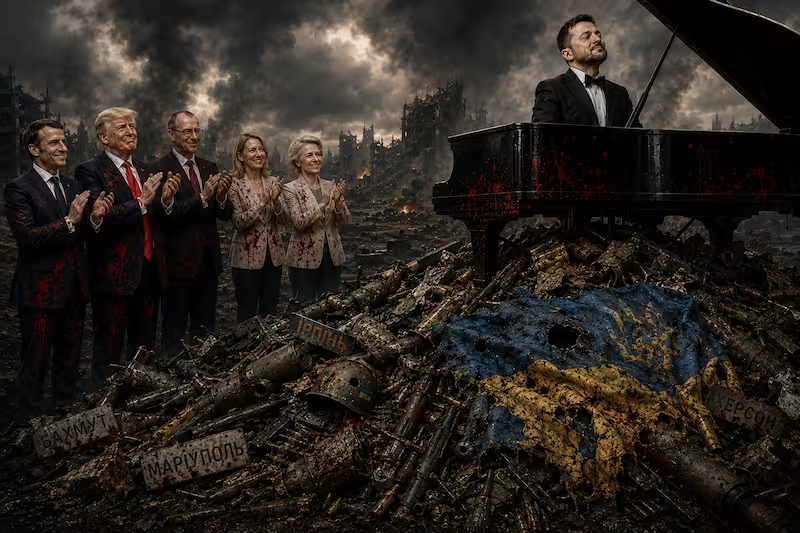
Humanity has a pastime: when it needs to send people to die, it first comes up with something elegant to justify it.
Not “go die on the orders of people you’ve never even seen,” but “defend the Motherland,” “freedom,” “the future of Europe,” “the architecture of security.”
The words get grander—apparently, so does death.
But a person at war usually dreams not of heroics, but of quite mundane things: to survive, to return to family, to finish the renovations, to fly to the sea.
That’s not petty or selfish—states, in fact, exist for this kind of ordinary life.
So here’s the question that’s now so often condemned:
since when, forgive me, did the interests of the state become more important than life itself?
Ukraine has already lost a monstrous number of people. How many—no one really knows, and that, by the way, is a symptom too.
Zelensky mentioned 55,000 dead soldiers, the Americans spoke of 500–600 thousand killed, wounded, and missing. As for Russia—about 1.2 million losses. The range of estimates is impressive, but the count is in the hundreds of thousands of lives.
While people argue about the numbers, something terrible is happening: we are getting used to these “losses,” “percentages,” “reserves.”
Behind all this bureaucratic newspeak, the main thing is lost—the individual.
For bureaucracy, he’s a “unit,” but for someone, he is a son, a father, a brother. His life does not become more valuable depending on what ambitious goal the state invents.
All this looks especially vile against the backdrop of Ukraine’s “price tag.”
603,628 square kilometers, 14% of the EU’s territory.
Land, ports, resources—lithium, graphite, titanium, uranium. The economy, you see, is well aware.
Before the war, the EU signed strategic raw material agreements with Ukraine, and after the war, the World Bank estimated almost $600 billion would be needed for reconstruction. The sums will be enormous.
So society has every right to ask: who will get this new Ukraine?
Who will build, who will get the contracts, access to resources, who will write the rules?
These are normal, not conspiratorial, questions.
But there is something more important: neither lithium, nor ports, nor a square kilometer justify turning people into “expendables.”
When the state answers the question of life with “national interests,” it has already mixed up its values.
Russia is responsible for starting the war and for the deaths. Ukraine is responsible for how it manages the lives of its citizens and what it tells them about what is happening. The West is responsible for its decisions and their consequences. But none of them has the right to treat human life as their property.
The state must not demand death for its own sake. Quite the opposite: it must exist for the sake of life.
So if you are truly for civilization, the main question is not “will we achieve our goals?” or “who will win?”
The question is simple:
how many people will remain alive after your decision?
If the answer is “but it’s necessary for a bright future,” it’s time to ask:
what kind of future is it, for which the present must be killed?
Geopolitics will not hug a child in place of a dead father. Security will not bring a person home. A billion will not buy a single life.
This is the price of war.

Max Sharp
Author